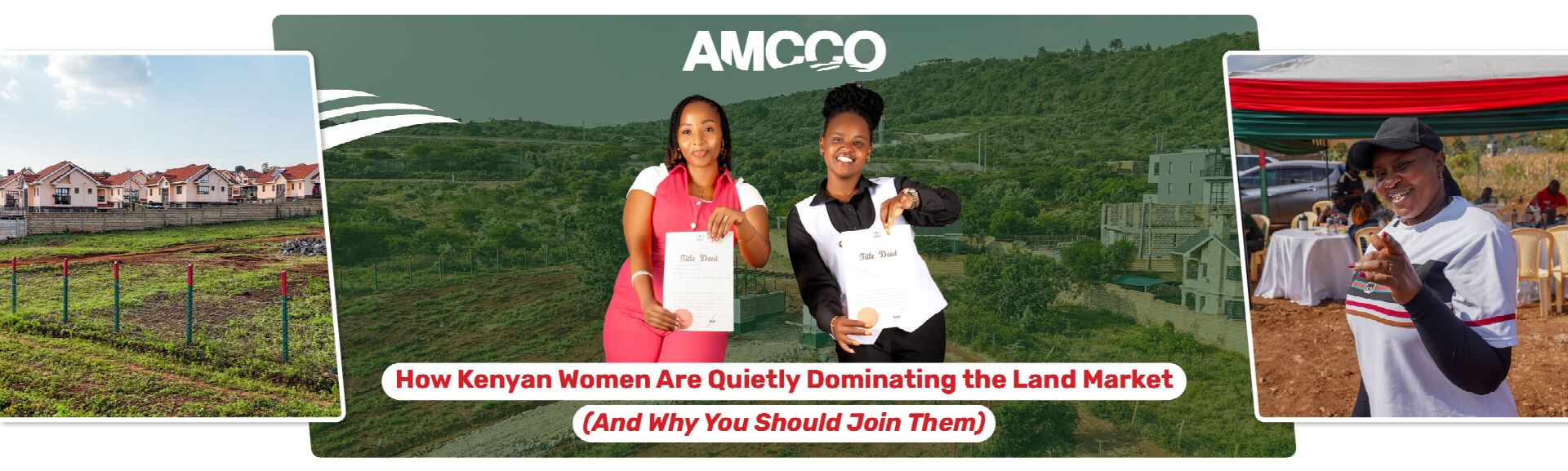
How Kenyan Women Are Quietly Dominating the Land Market In 2026 And Why You Should Join Them
Discover how Kenyan women are building wealth through real estate. Secure your financial future today with prime, value-added plots for sale in Thika Road, Ngong, and Kikuyu with ready title deeds.
How Kenyan Women Are Quietly Dominating the Land Market — And Why You Should Join Them
For years, land investment in Kenya has often been viewed as a man’s game. But quietly, that narrative is changing.
Across the country, more Kenyan women are making independent financial decisions, buying property, securing title deeds, and building long-term wealth through real estate. They may not always make headlines, but their growing participation in property ownership is impossible to ignore.
According to the Kenya National Bureau of Statistics (KNBS), 27% of women aged 15–49 reported owning land either alone or jointly with a spouse or partner, while 33% reported owning a house either alone or jointly.
And this is more than simply owning a piece of land. It is about financial independence, security, and creating assets that can appreciate over time. At our real estate company, we are proud to be the trusted partner helping women secure their futures with prime, value-added plots in Kenya's fastest-growing corridors: Thika Road, Ngong, and Kikuyu.
Why Are More Women Investing in Land?
1. Women Are Thinking Long-Term
Land is increasingly being viewed by women as a long-term wealth-building asset. Instead of spending all their income on short-term consumption, some women are choosing to put part of their earnings into property. A plot bought today can become a home, a rental property, a commercial development, or simply an appreciating asset in the future. For many, the goal isn't immediate returns. It is having something tangible they can call their own.
2. Land Provides Financial Security
Property ownership can provide an important layer of financial security. The World Bank notes that secure housing and land rights can improve women's economic independence, bargaining power, and access to economic opportunities. For a woman, owning land independently—or jointly with a spouse—can therefore represent much more than an investment. It can mean having an asset to fall back on when circumstances change.
3. Women Are Becoming More Financially Empowered
Kenyan women are increasingly participating in decisions about household finances and major purchases. KNBS data shows that 78% of married women participate in decisions about major household purchases.
That financial decision-making power can translate into investment decisions—including property. And with digital banking, mobile money, chama structures, and easier access to financial information, investing is no longer something reserved for people with large amounts of capital or extensive financial networks.
4. Land Can Be a Legacy
One of the strongest reasons to own land is what happens beyond the individual investor. A woman who buys a plot today can eventually build a home for her family, develop rental units, establish business premises, or leave the property to her children. In other words, one land purchase can become a foundation for generational wealth.
Beyond the immediate financial security it provides, land is a timeless asset that multiplies in value while requiring zero maintenance costs. By securing a plot today along growing infrastructure corridors like Thika Road, Ngong, or Kikuyu, you ensure that your children will never have to start their financial journeys from zero. They will have a valuable asset to leverage for university tuition, capital to fund their own business ventures, or a secure place to build their own homes.
Furthermore, a mother who actively participates in real estate changes how her children view wealth creation, passing down essential financial literacy alongside physical property. You are effectively shifting your family's future from the cycle of endless monthly rent to the freedom of permanent land ownership. Ultimately, leaving a land legacy means giving your family a permanent piece of Kenya that they can always call home.
Choosing Your Frontier: Thika Road, Ngong, or Kikuyu?
To help you join this movement, our company has secured premier, verified plots with ready title deeds in three strategic locations. Depending on your personal wealth-building strategy, you can find your perfect match here:
Thika Road (The Commercial Powerhouse): Ideal for the visionary woman looking to build multi-unit residential apartments or commercial spaces. Powered by universities, malls, and an 8-lane superhighway, the rental demand here is exceptionally high.
Ngong (The Scenic Family Haven): Perfect for mothers and families looking to build a customized suburban home or a serene retirement villa. With gated communities, fresh air, and proximity to the SGR station, it offers an unmatched living environment.
Kikuyu (The Connected Commuter Goldmine): Best for fast-paced professional women who want a hassle-free, fast commute to Westlands or the Nairobi CBD via the Southern Bypass. It is a highly developed area ready for immediate settlement.
But There Is Still a Long Way to Go
The growth in women's participation shouldn't hide the existing gender gap. World Bank data based on the 2022 KDHS indicates that only 3.1% of Kenyan women owned agricultural land alone, compared with 24.3% of men; for non-agricultural land, the figures were 1.4% for women and 6.4% for men.
This makes every woman who deliberately enters the property market part of a much bigger shift. The opportunity isn't simply to catch up. It is to change the traditional perception that property ownership is primarily a man's responsibility.
Overcoming the Margins: Breaking Down the Statistics
When we examine independent property ownership in Kenya, the stark contrast between genders becomes clear. In agricultural sectors, a mere three point one percent of women hold sole ownership of land, compared to nearly a quarter of all men at twenty-four point three percent. This gap extends heavily into non-agricultural and commercial sectors as well, where only one point four percent of women hold independent property titles compared to six point four percent of their male counterparts.
General housing trends display similar disparities. Only five percent of women own a residential home completely independently, while men hold a dominant thirty-five percent share of sole homeownership. However, looking at the total landscape—which includes both independent and joint marital investments—we see progress. Total land ownership, whether alone or jointly, stands at twenty-seven percent for women compared to thirty-four percent for men. Similarly, thirty-three percent of women are registered on house titles alone or jointly, compared to forty-five percent of men.
Geography and infrastructure also play massive roles in these dynamics. In rural areas, women achieve a forty-three point seven percent share of property ownership compared to fifty-two point one percent for men, largely due to customary family settlements. Yet this figure plummets in competitive urban markets, where women hold a mere seventeen point one percent share of property ownership compared to over thirty-eight point four percent for men. Additionally, access to basic infrastructure on owned land remains heavily skewed; only nine percent of female-owned parcels enjoy direct connection to piped utilities, while seventy-three percent of male property owners have this access, though many still lack formal government-recognized documentation or title deeds. Finally, as the real estate market digitizes, smartphone ownership—the ultimate gateway to checking land records online—stands at forty-three percent for women compared to forty-nine percent for men.
Every single woman who deliberately chooses to invest in property becomes part of a historic macroeconomic correction. The ultimate goal isn't just to play catch-up with the numbers; it is to permanently dismantle the archaic notion that property ownership is strictly a man's responsibility.
Bridge the Gap Today with Our Prime Plots
This statistical disparity is precisely why our prime real estate projects along Thika Road, Ngong, and Kikuyu are intentionally structured to empower female buyers. By providing affordable entry prices, flexible monthly payment installments, and seamlessly processed title deeds registered directly in your name, we completely eliminate the traditional barriers to real estate entry.
Whether you want a high-density commercial plot along Thika Road to generate passive rental income, a serene suburban plot in Ngong to build a peaceful family home, or a highly connected commuter plot in Kikuyu for rapid capital appreciation, we provide the clean legal framework you need to move from a statistic to a proud landowner.
Turn Statistics Into Direct Personal Action
This statistical disparity is precisely why our prime real estate projects along Thika Road, Ngong, and Kikuyu are intentionally structured to empower female buyers. By providing affordable entry prices, flexible monthly payment installments, and seamlessly processed title deeds registered directly in your name, we completely eliminate the traditional barriers to real estate entry.
Whether you want a high-density commercial plot along Thika Road to generate passive rental income, a serene suburban plot in Ngong to build a peaceful family home, or a highly connected commuter plot in Kikuyu for rapid capital appreciation, we provide the clean legal framework you need to move from a statistic to a proud landowner.
So, Why Should You Join Them?
You don't necessarily need to start with a huge piece of land or a multimillion-shilling property. Start with what you can afford.
Research the location. Look at infrastructure, accessibility, development trends, and future demand. Most importantly, verify ownership documents and conduct proper due diligence before purchasing. Kenya's 2023/24 Housing Survey found that 31% of land parcels were acquired through purchase, while title deeds were the most common form of ownership documentation at 66%.
When you buy through our company, we eliminate the guesswork. All our plots across Thika Road, Ngong, and Kikuyu come with 100% clean, verifiable records and ready title deeds processed quickly into your name. We also offer flexible installments and chama-friendly payment plans to match your budget.
The lesson is simple: don't wait until you can afford the biggest investment. Start with a smart one.
The Future of Land Investment Is More Inclusive
The Kenyan property market is changing. Women are not simply participating in the land market—they are increasingly making property ownership part of their financial plans.
Whether you're a young professional buying your first plot, a mother securing land for your children, an entrepreneur planning for future expansion, or simply someone looking for a tangible asset, land can play an important role in your financial journey.
The women investing today aren't wedding themselves to the idea of being wealthy before buying land. They're using property ownership as one of the ways to build that wealth.
So the question isn't whether women should invest in land.
The better question is: What are you waiting for?
Ready to start your land ownership journey with confidence?
📲 WhatsApp: AMCCO Properties
📞 Kikuyu Office: +254 701 293 199
📞 Ngong Office: +254 722 993 030
📞 Diaspora: +254720 009 005
📧 Email: diaspora@amcco.co.ke
Your future begins with one smart decision you make now
%20(2).jpg)

